Why Creative Is the #1 Variable in Meta Ads
Why Creative Is the #1 Variable in Meta Ads
Creative drives 56% of digital ad sales lift — more than targeting, bidding, or budget. Here is what changed, what works on Meta Ads now, and how to build a creative system that does not burn out.
Insights

You can have perfect targeting. Wrong creative kills it anyway.
A few years ago, Meta Ads success was built on the ability to laser-target. Find the right audience, set the right bid, run a decent ad. The creative mattered, but the targeting did most of the heavy lifting.
That version no longer works.
Post-iOS 14, Meta's third-party audience data took a serious hit. Apple's App Tracking Transparency meant most users opted out of tracking. Broad audiences became the new norm. Interest targeting lost a lot of precision. The algorithm had to lean much harder on its own signals.
What that means: your creative is now the most important targeting tool you have.
The algorithm reads who engages with your ad, who clicks, who watches to the end — and finds more people who match that profile. A great creative that resonates deeply with a specific type of person will find more of those people, even in a broad audience. A generic creative finds nobody in particular.
Research from Nielsen backs this up: creative quality accounts for 56% of digital ad sales lift — more than audience targeting, more than bidding strategy, more than the brand itself. Creative is, by a significant margin, the single most important variable in your Meta campaigns.
What Kinds of Meta Ad Creative Work in 2026
The creative that dominated three years ago was polished. Clean studio photography. High-production video. Clear branding. High production value was a proxy for legitimacy.
The creative that performs now is different.
The feeds on Instagram and Facebook are full of organic content from real people — phone videos, casual talking-to-camera clips, screenshots, unboxing footage. The algorithm serves ads into that same feed. Highly produced content stands out, but not in the way you want. It signals "this is an ad." People scroll past ads.
Native-feeling creative — content that looks like it was made by a real person rather than a brand — gets treated differently. It doesn't trigger the automatic scroll. It gets watched.
This is why user-generated content (UGC) style ads have dominated performance for the past two years and show no sign of slowing. It's not that UGC is inherently better creative. It's that it doesn't look like an ad.
What native-feel creative looks like in practice:
Phone-shot video, slightly imperfect framing
Someone talking to camera about the product — genuine, not over-scripted
On-screen text captions (most people watch with sound off)
Real environments: living rooms, kitchens, nurseries — not studios
Honest reactions: what they expected vs what they actually got
This doesn't mean abandoning polished creative entirely. Static photography still works for certain placements and audiences. But the default bias should be toward native-feel over produced, especially for cold prospecting.

How to Write a Strong Meta Ads Hook
You have roughly two seconds to stop a scroll before the user moves on.
The hook is the first frame of your video or the headline and opening line of a static ad. If the hook doesn't work, the rest is irrelevant — because most people who see the ad will never get there.
A strong hook does one of three things:
Names the specific person the ad is for: "If you're setting up your first nursery..."
Creates immediate curiosity: "The one thing nobody tells you about buying a cot"
Leads with a specific outcome: "We hit $100k a month in D2C sales. Here's exactly how."
A weak hook is generic, vague, or starts with the brand name. "Introducing Cocoon Furniture" is not a hook. Nobody cares about an introduction.
Before you test audiences, before you test bids — test hooks. A better hook is worth more than any other variable in your campaign.
The Three Creative Angles Every Meta Campaign Should Test
Not every customer responds to the same message. For any product, there are at least three distinct emotional motivations that can drive a purchase.
Pain angle — lead with the problem. What frustration, anxiety, or gap is the buyer dealing with right now? Speak to that first. For premium nursery furniture: the anxiety of getting the wrong cot, the regret of buying cheap and replacing it six months later, the chaos of a product that doesn't survive the second child.
Outcome angle — lead with the result. What does life look like after this purchase? Less worry. More time. A nursery that feels right. The version of the story where things worked out.
Proof angle — lead with validation from real customers. Other parents chose this. Other parents had the same hesitations. Here's what they said after.
Each angle works for different people at different stages of awareness. Pain tends to win with cold audiences who haven't thought about the problem yet. Proof tends to win with warm audiences who know the product but need permission to buy. Outcome tends to work with aspirational buyers focused on where they're going.
Never assume which angle works for your audience. Test all three. Let performance tell you.

Understanding and Preventing Meta Ad Creative Fatigue
Every ad fatigues eventually. Audiences are finite. Once your ad has been served to a large portion of the people who might buy from you, performance drops — not because the ad was bad, but because the same people have seen it too many times.
This is creative fatigue. It happens to every account, every time.
The mistake most brands make is not planning for it. They find something that works, they scale it, and when performance starts to dip they scramble to replace it. By the time new creative is ready, they've had two or three weeks of deteriorating results.
The better approach: treat creative as an ongoing production process, not a one-time task.
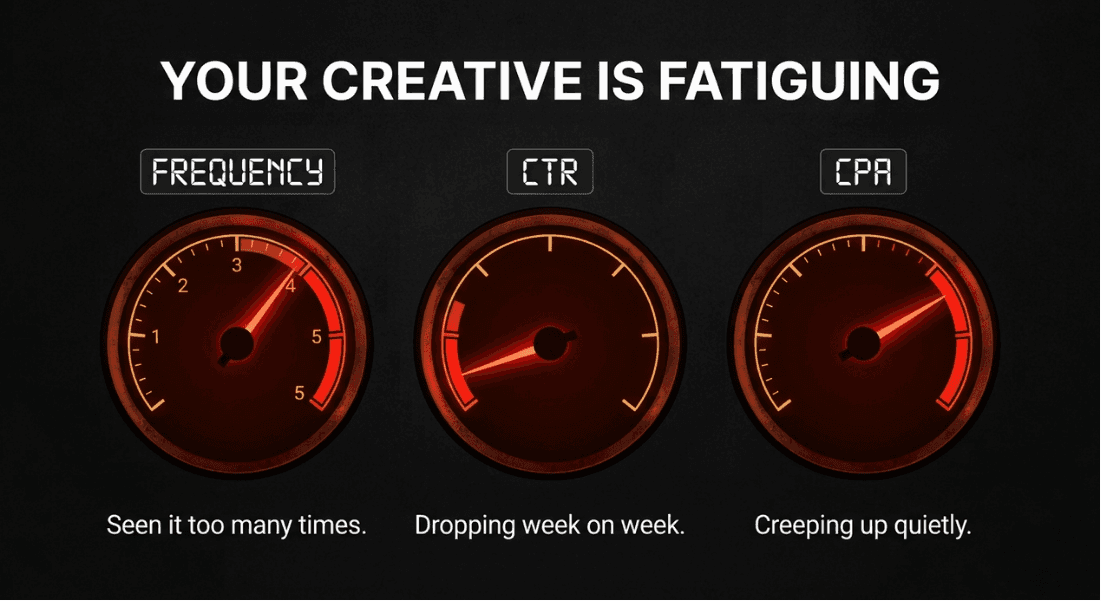
Signs your Meta ad creative is fatiguing:
Frequency climbing above 3 (average users seeing the ad more than three times)
CTR declining over a two-week window even as spend stays flat
CPA creeping up without any campaign changes
A practical refresh cadence:
Plan new creative batches every 2-3 weeks
Brief new creative before you need it, not after performance drops
Top-performing D2C brands run 8-12 new ad variations per week at scale
You don't need that volume at the start. But you need more creative, earlier, than most founders plan for.
Building a Meta Ads Creative System (Not Just a One-Off Creative)
The shift from "make an ad" to "run a creative system" is one of the most important changes you can make in how you approach Meta Ads.
A creative system has four components:
A testing framework. What variables are you testing in each creative batch? Hook, angle, format, length? Pick one or two variables per batch so you can draw clear conclusions.
A production process. Who makes the creative, on what timeline, to what brief? If creative production is chaotic, it will always lag behind what the campaigns need.
An analysis process. How do you read creative performance data and feed it back into the next batch? Every creative that runs teaches you something. A hook that outperforms by 40% tells you something specific about what resonates with your audience.
A refresh schedule. When does new creative need to be ready? Set a calendar date. Don't wait for performance to drop.
The creative that works today is built on what you learned from the creative that ran last month. That only happens if there's a system capturing and applying those learnings — not just a folder of old ads.

Where to Start If You're Running Meta Ads Right Now
If you haven't refreshed creative in the last three weeks, performance is probably already declining — even if the dashboard hasn't shown it yet.
Start here:
Pull your top three performing creatives from the last 90 days. What do they have in common? That's a signal about what your audience responds to.
Test at least one new hook variant against your current best performer this week.
If you only have polished creative in market, build one native-feel piece — a real customer talking about the product, filmed on a phone.
Set a calendar reminder two weeks from now to review performance and brief the next creative batch.
Creative isn't a task you complete once. It's a process you run continuously. The brands that build that process and feed it consistently are the ones that scale on Meta without the economics falling apart.
Frequently Asked Questions About Meta Ads Creative Strategy
How often should I change my Meta Ads creative? Plan to refresh creative every 2-3 weeks as a baseline. Watch for frequency (above 3) and declining CTR as early signals of fatigue. Don't wait for CPA to spike before you act — by then you're already behind. Brief new creative before you need it.
What makes a good Meta Ads hook? A good hook stops the scroll in the first two seconds by either naming exactly who the ad is for, creating immediate curiosity about something specific, or leading with a concrete outcome. It should feel like it was written for one person, not a broad audience. Avoid starting with your brand name.
Should I use UGC or professional video for Meta Ads? Test both. In 2026, native-feel UGC-style video generally outperforms polished production for cold prospecting because it doesn't look like an ad. Polished creative can still work for retargeting and brand-building campaigns. Your audience will tell you which they prefer if you test both properly.
How do I know if my Meta ad creative is fatigued? Watch three metrics: frequency (above 3 means most of your audience has seen it multiple times), CTR trend over 14 days (declining without budget changes suggests fatigue), and CPA trend (rising without campaign changes is a lagging indicator). Frequency and CTR will flag it first.
How many ad creatives should I be testing at once? At early stage, start with 3-5 variations testing one variable at a time (e.g. three different hooks with the same creative format). At scale, top-performing brands run 8-12 variations per week. More isn't better until you have a system for analysing what the data is telling you.

More to Discover


Why Creative Is the #1 Variable in Meta Ads
Why Creative Is the #1 Variable in Meta Ads
Creative drives 56% of digital ad sales lift — more than targeting, bidding, or budget. Here is what changed, what works on Meta Ads now, and how to build a creative system that does not burn out.
Insights
You can have perfect targeting. Wrong creative kills it anyway.
A few years ago, Meta Ads success was built on the ability to laser-target. Find the right audience, set the right bid, run a decent ad. The creative mattered, but the targeting did most of the heavy lifting.
That version no longer works.
Post-iOS 14, Meta's third-party audience data took a serious hit. Apple's App Tracking Transparency meant most users opted out of tracking. Broad audiences became the new norm. Interest targeting lost a lot of precision. The algorithm had to lean much harder on its own signals.
What that means: your creative is now the most important targeting tool you have.
The algorithm reads who engages with your ad, who clicks, who watches to the end — and finds more people who match that profile. A great creative that resonates deeply with a specific type of person will find more of those people, even in a broad audience. A generic creative finds nobody in particular.
Research from Nielsen backs this up: creative quality accounts for 56% of digital ad sales lift — more than audience targeting, more than bidding strategy, more than the brand itself. Creative is, by a significant margin, the single most important variable in your Meta campaigns.
What Kinds of Meta Ad Creative Work in 2026
The creative that dominated three years ago was polished. Clean studio photography. High-production video. Clear branding. High production value was a proxy for legitimacy.
The creative that performs now is different.
The feeds on Instagram and Facebook are full of organic content from real people — phone videos, casual talking-to-camera clips, screenshots, unboxing footage. The algorithm serves ads into that same feed. Highly produced content stands out, but not in the way you want. It signals "this is an ad." People scroll past ads.
Native-feeling creative — content that looks like it was made by a real person rather than a brand — gets treated differently. It doesn't trigger the automatic scroll. It gets watched.
This is why user-generated content (UGC) style ads have dominated performance for the past two years and show no sign of slowing. It's not that UGC is inherently better creative. It's that it doesn't look like an ad.
What native-feel creative looks like in practice:
Phone-shot video, slightly imperfect framing
Someone talking to camera about the product — genuine, not over-scripted
On-screen text captions (most people watch with sound off)
Real environments: living rooms, kitchens, nurseries — not studios
Honest reactions: what they expected vs what they actually got
This doesn't mean abandoning polished creative entirely. Static photography still works for certain placements and audiences. But the default bias should be toward native-feel over produced, especially for cold prospecting.
How to Write a Strong Meta Ads Hook
You have roughly two seconds to stop a scroll before the user moves on.
The hook is the first frame of your video or the headline and opening line of a static ad. If the hook doesn't work, the rest is irrelevant — because most people who see the ad will never get there.
A strong hook does one of three things:
Names the specific person the ad is for: "If you're setting up your first nursery..."
Creates immediate curiosity: "The one thing nobody tells you about buying a cot"
Leads with a specific outcome: "We hit $100k a month in D2C sales. Here's exactly how."
A weak hook is generic, vague, or starts with the brand name. "Introducing Cocoon Furniture" is not a hook. Nobody cares about an introduction.
Before you test audiences, before you test bids — test hooks. A better hook is worth more than any other variable in your campaign.
The Three Creative Angles Every Meta Campaign Should Test
Not every customer responds to the same message. For any product, there are at least three distinct emotional motivations that can drive a purchase.
Pain angle — lead with the problem. What frustration, anxiety, or gap is the buyer dealing with right now? Speak to that first. For premium nursery furniture: the anxiety of getting the wrong cot, the regret of buying cheap and replacing it six months later, the chaos of a product that doesn't survive the second child.
Outcome angle — lead with the result. What does life look like after this purchase? Less worry. More time. A nursery that feels right. The version of the story where things worked out.
Proof angle — lead with validation from real customers. Other parents chose this. Other parents had the same hesitations. Here's what they said after.
Each angle works for different people at different stages of awareness. Pain tends to win with cold audiences who haven't thought about the problem yet. Proof tends to win with warm audiences who know the product but need permission to buy. Outcome tends to work with aspirational buyers focused on where they're going.
Never assume which angle works for your audience. Test all three. Let performance tell you.
Understanding and Preventing Meta Ad Creative Fatigue
Every ad fatigues eventually. Audiences are finite. Once your ad has been served to a large portion of the people who might buy from you, performance drops — not because the ad was bad, but because the same people have seen it too many times.
This is creative fatigue. It happens to every account, every time.
The mistake most brands make is not planning for it. They find something that works, they scale it, and when performance starts to dip they scramble to replace it. By the time new creative is ready, they've had two or three weeks of deteriorating results.
The better approach: treat creative as an ongoing production process, not a one-time task.
Signs your Meta ad creative is fatiguing:
Frequency climbing above 3 (average users seeing the ad more than three times)
CTR declining over a two-week window even as spend stays flat
CPA creeping up without any campaign changes
A practical refresh cadence:
Plan new creative batches every 2-3 weeks
Brief new creative before you need it, not after performance drops
Top-performing D2C brands run 8-12 new ad variations per week at scale
You don't need that volume at the start. But you need more creative, earlier, than most founders plan for.
Building a Meta Ads Creative System (Not Just a One-Off Creative)
The shift from "make an ad" to "run a creative system" is one of the most important changes you can make in how you approach Meta Ads.
A creative system has four components:
A testing framework. What variables are you testing in each creative batch? Hook, angle, format, length? Pick one or two variables per batch so you can draw clear conclusions.
A production process. Who makes the creative, on what timeline, to what brief? If creative production is chaotic, it will always lag behind what the campaigns need.
An analysis process. How do you read creative performance data and feed it back into the next batch? Every creative that runs teaches you something. A hook that outperforms by 40% tells you something specific about what resonates with your audience.
A refresh schedule. When does new creative need to be ready? Set a calendar date. Don't wait for performance to drop.
The creative that works today is built on what you learned from the creative that ran last month. That only happens if there's a system capturing and applying those learnings — not just a folder of old ads.
Where to Start If You're Running Meta Ads Right Now
If you haven't refreshed creative in the last three weeks, performance is probably already declining — even if the dashboard hasn't shown it yet.
Start here:
Pull your top three performing creatives from the last 90 days. What do they have in common? That's a signal about what your audience responds to.
Test at least one new hook variant against your current best performer this week.
If you only have polished creative in market, build one native-feel piece — a real customer talking about the product, filmed on a phone.
Set a calendar reminder two weeks from now to review performance and brief the next creative batch.
Creative isn't a task you complete once. It's a process you run continuously. The brands that build that process and feed it consistently are the ones that scale on Meta without the economics falling apart.
Frequently Asked Questions About Meta Ads Creative Strategy
How often should I change my Meta Ads creative? Plan to refresh creative every 2-3 weeks as a baseline. Watch for frequency (above 3) and declining CTR as early signals of fatigue. Don't wait for CPA to spike before you act — by then you're already behind. Brief new creative before you need it.
What makes a good Meta Ads hook? A good hook stops the scroll in the first two seconds by either naming exactly who the ad is for, creating immediate curiosity about something specific, or leading with a concrete outcome. It should feel like it was written for one person, not a broad audience. Avoid starting with your brand name.
Should I use UGC or professional video for Meta Ads? Test both. In 2026, native-feel UGC-style video generally outperforms polished production for cold prospecting because it doesn't look like an ad. Polished creative can still work for retargeting and brand-building campaigns. Your audience will tell you which they prefer if you test both properly.
How do I know if my Meta ad creative is fatigued? Watch three metrics: frequency (above 3 means most of your audience has seen it multiple times), CTR trend over 14 days (declining without budget changes suggests fatigue), and CPA trend (rising without campaign changes is a lagging indicator). Frequency and CTR will flag it first.
How many ad creatives should I be testing at once? At early stage, start with 3-5 variations testing one variable at a time (e.g. three different hooks with the same creative format). At scale, top-performing brands run 8-12 variations per week. More isn't better until you have a system for analysing what the data is telling you.
More to Discover
Why Creative Is the #1 Variable in Meta Ads
Why Creative Is the #1 Variable in Meta Ads
Creative drives 56% of digital ad sales lift — more than targeting, bidding, or budget. Here is what changed, what works on Meta Ads now, and how to build a creative system that does not burn out.
Insights
You can have perfect targeting. Wrong creative kills it anyway.
A few years ago, Meta Ads success was built on the ability to laser-target. Find the right audience, set the right bid, run a decent ad. The creative mattered, but the targeting did most of the heavy lifting.
That version no longer works.
Post-iOS 14, Meta's third-party audience data took a serious hit. Apple's App Tracking Transparency meant most users opted out of tracking. Broad audiences became the new norm. Interest targeting lost a lot of precision. The algorithm had to lean much harder on its own signals.
What that means: your creative is now the most important targeting tool you have.
The algorithm reads who engages with your ad, who clicks, who watches to the end — and finds more people who match that profile. A great creative that resonates deeply with a specific type of person will find more of those people, even in a broad audience. A generic creative finds nobody in particular.
Research from Nielsen backs this up: creative quality accounts for 56% of digital ad sales lift — more than audience targeting, more than bidding strategy, more than the brand itself. Creative is, by a significant margin, the single most important variable in your Meta campaigns.
What Kinds of Meta Ad Creative Work in 2026
The creative that dominated three years ago was polished. Clean studio photography. High-production video. Clear branding. High production value was a proxy for legitimacy.
The creative that performs now is different.
The feeds on Instagram and Facebook are full of organic content from real people — phone videos, casual talking-to-camera clips, screenshots, unboxing footage. The algorithm serves ads into that same feed. Highly produced content stands out, but not in the way you want. It signals "this is an ad." People scroll past ads.
Native-feeling creative — content that looks like it was made by a real person rather than a brand — gets treated differently. It doesn't trigger the automatic scroll. It gets watched.
This is why user-generated content (UGC) style ads have dominated performance for the past two years and show no sign of slowing. It's not that UGC is inherently better creative. It's that it doesn't look like an ad.
What native-feel creative looks like in practice:
Phone-shot video, slightly imperfect framing
Someone talking to camera about the product — genuine, not over-scripted
On-screen text captions (most people watch with sound off)
Real environments: living rooms, kitchens, nurseries — not studios
Honest reactions: what they expected vs what they actually got
This doesn't mean abandoning polished creative entirely. Static photography still works for certain placements and audiences. But the default bias should be toward native-feel over produced, especially for cold prospecting.
How to Write a Strong Meta Ads Hook
You have roughly two seconds to stop a scroll before the user moves on.
The hook is the first frame of your video or the headline and opening line of a static ad. If the hook doesn't work, the rest is irrelevant — because most people who see the ad will never get there.
A strong hook does one of three things:
Names the specific person the ad is for: "If you're setting up your first nursery..."
Creates immediate curiosity: "The one thing nobody tells you about buying a cot"
Leads with a specific outcome: "We hit $100k a month in D2C sales. Here's exactly how."
A weak hook is generic, vague, or starts with the brand name. "Introducing Cocoon Furniture" is not a hook. Nobody cares about an introduction.
Before you test audiences, before you test bids — test hooks. A better hook is worth more than any other variable in your campaign.
The Three Creative Angles Every Meta Campaign Should Test
Not every customer responds to the same message. For any product, there are at least three distinct emotional motivations that can drive a purchase.
Pain angle — lead with the problem. What frustration, anxiety, or gap is the buyer dealing with right now? Speak to that first. For premium nursery furniture: the anxiety of getting the wrong cot, the regret of buying cheap and replacing it six months later, the chaos of a product that doesn't survive the second child.
Outcome angle — lead with the result. What does life look like after this purchase? Less worry. More time. A nursery that feels right. The version of the story where things worked out.
Proof angle — lead with validation from real customers. Other parents chose this. Other parents had the same hesitations. Here's what they said after.
Each angle works for different people at different stages of awareness. Pain tends to win with cold audiences who haven't thought about the problem yet. Proof tends to win with warm audiences who know the product but need permission to buy. Outcome tends to work with aspirational buyers focused on where they're going.
Never assume which angle works for your audience. Test all three. Let performance tell you.
Understanding and Preventing Meta Ad Creative Fatigue
Every ad fatigues eventually. Audiences are finite. Once your ad has been served to a large portion of the people who might buy from you, performance drops — not because the ad was bad, but because the same people have seen it too many times.
This is creative fatigue. It happens to every account, every time.
The mistake most brands make is not planning for it. They find something that works, they scale it, and when performance starts to dip they scramble to replace it. By the time new creative is ready, they've had two or three weeks of deteriorating results.
The better approach: treat creative as an ongoing production process, not a one-time task.
Signs your Meta ad creative is fatiguing:
Frequency climbing above 3 (average users seeing the ad more than three times)
CTR declining over a two-week window even as spend stays flat
CPA creeping up without any campaign changes
A practical refresh cadence:
Plan new creative batches every 2-3 weeks
Brief new creative before you need it, not after performance drops
Top-performing D2C brands run 8-12 new ad variations per week at scale
You don't need that volume at the start. But you need more creative, earlier, than most founders plan for.
Building a Meta Ads Creative System (Not Just a One-Off Creative)
The shift from "make an ad" to "run a creative system" is one of the most important changes you can make in how you approach Meta Ads.
A creative system has four components:
A testing framework. What variables are you testing in each creative batch? Hook, angle, format, length? Pick one or two variables per batch so you can draw clear conclusions.
A production process. Who makes the creative, on what timeline, to what brief? If creative production is chaotic, it will always lag behind what the campaigns need.
An analysis process. How do you read creative performance data and feed it back into the next batch? Every creative that runs teaches you something. A hook that outperforms by 40% tells you something specific about what resonates with your audience.
A refresh schedule. When does new creative need to be ready? Set a calendar date. Don't wait for performance to drop.
The creative that works today is built on what you learned from the creative that ran last month. That only happens if there's a system capturing and applying those learnings — not just a folder of old ads.
Where to Start If You're Running Meta Ads Right Now
If you haven't refreshed creative in the last three weeks, performance is probably already declining — even if the dashboard hasn't shown it yet.
Start here:
Pull your top three performing creatives from the last 90 days. What do they have in common? That's a signal about what your audience responds to.
Test at least one new hook variant against your current best performer this week.
If you only have polished creative in market, build one native-feel piece — a real customer talking about the product, filmed on a phone.
Set a calendar reminder two weeks from now to review performance and brief the next creative batch.
Creative isn't a task you complete once. It's a process you run continuously. The brands that build that process and feed it consistently are the ones that scale on Meta without the economics falling apart.
Frequently Asked Questions About Meta Ads Creative Strategy
How often should I change my Meta Ads creative? Plan to refresh creative every 2-3 weeks as a baseline. Watch for frequency (above 3) and declining CTR as early signals of fatigue. Don't wait for CPA to spike before you act — by then you're already behind. Brief new creative before you need it.
What makes a good Meta Ads hook? A good hook stops the scroll in the first two seconds by either naming exactly who the ad is for, creating immediate curiosity about something specific, or leading with a concrete outcome. It should feel like it was written for one person, not a broad audience. Avoid starting with your brand name.
Should I use UGC or professional video for Meta Ads? Test both. In 2026, native-feel UGC-style video generally outperforms polished production for cold prospecting because it doesn't look like an ad. Polished creative can still work for retargeting and brand-building campaigns. Your audience will tell you which they prefer if you test both properly.
How do I know if my Meta ad creative is fatigued? Watch three metrics: frequency (above 3 means most of your audience has seen it multiple times), CTR trend over 14 days (declining without budget changes suggests fatigue), and CPA trend (rising without campaign changes is a lagging indicator). Frequency and CTR will flag it first.
How many ad creatives should I be testing at once? At early stage, start with 3-5 variations testing one variable at a time (e.g. three different hooks with the same creative format). At scale, top-performing brands run 8-12 variations per week. More isn't better until you have a system for analysing what the data is telling you.