Academic Work
Uber - CX Design
Older Australians were opting out of Uber, and no app update was going to fix it. I ran primary research across interviews, ethnography and eight Reddit communities. Two solutions designed from scratch, prototyped and tested with real users.
Year :
2025
Industry :
Ride-sharing / Tech
Brand :
Uber (academic engagement)
Project Duration :
24 Weeks
Problem :
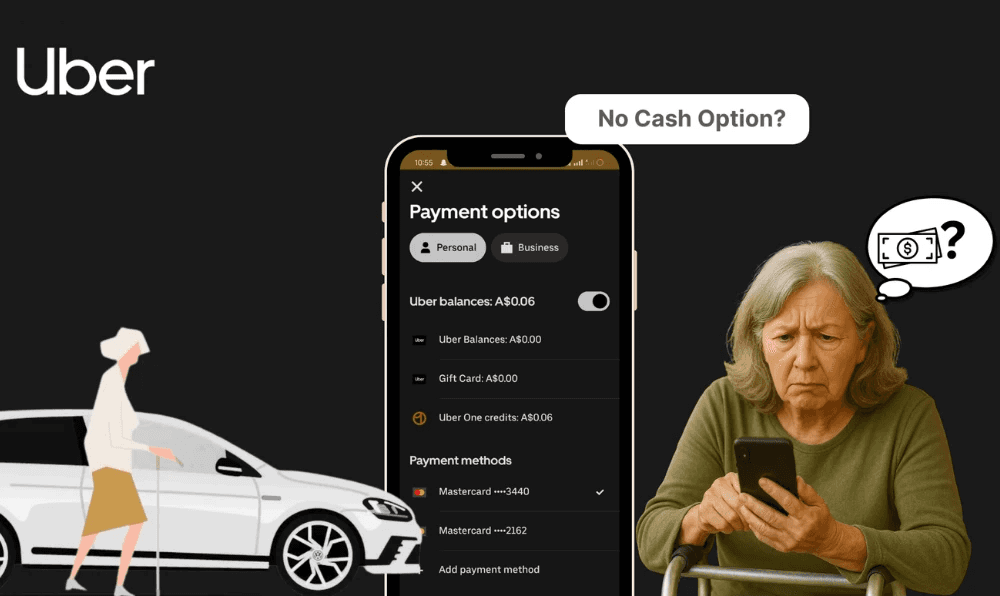
Older Australians were opting out of Uber. Not because the product was broken, but because the confidence to use it wasn't there. I ran primary research across three methods: in-depth interviews with Australians over 65, ethnographic observation, and analysis across eight Reddit communities.
What came back was consistent. Cancellations created lasting anxiety that stopped people booking again. The app needed more confidence than most older users had going in. And rideshare wasn't how this group thought about getting around in the first place. The problem wasn't the interface.
Solution :
Two solutions, both designed to sit inside Uber's existing infrastructure.
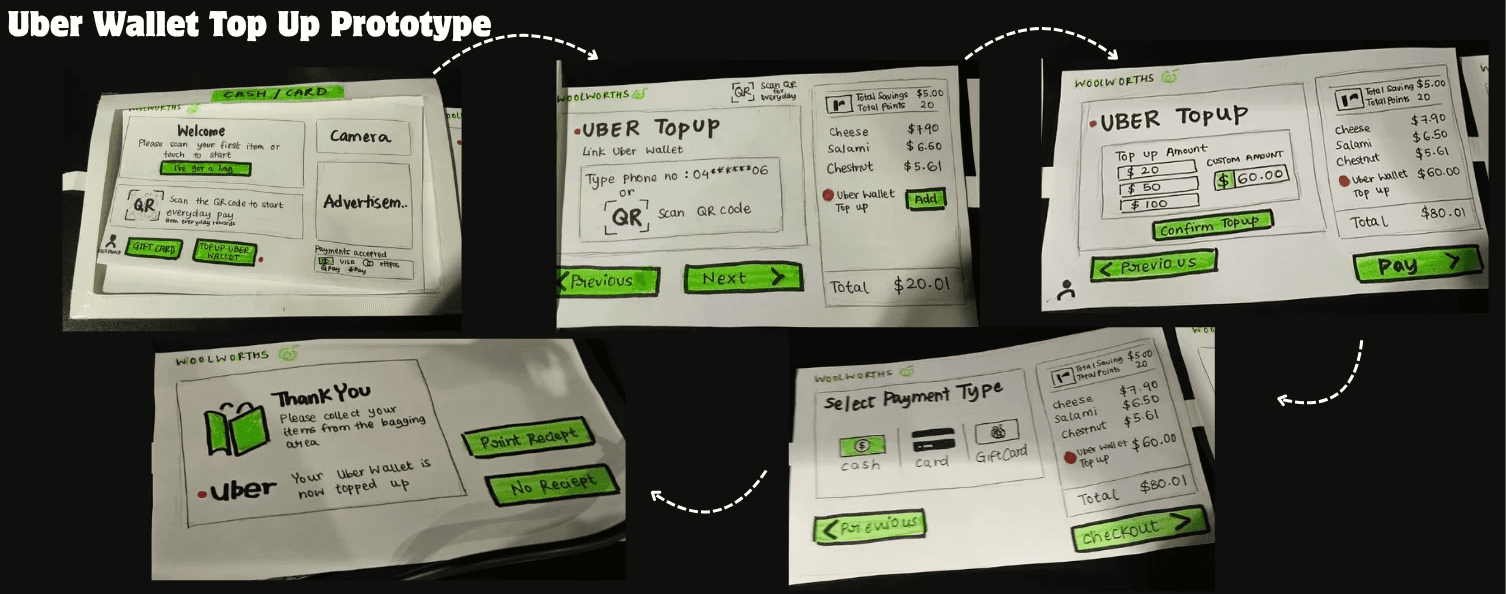
The first: an Uber Wallet top-up at Woolworths. Cash or card at self-checkout, no card on file required. Older Australians trust Woolworths and already go there. The top-up sits inside a system they know rather than one they have to learn.
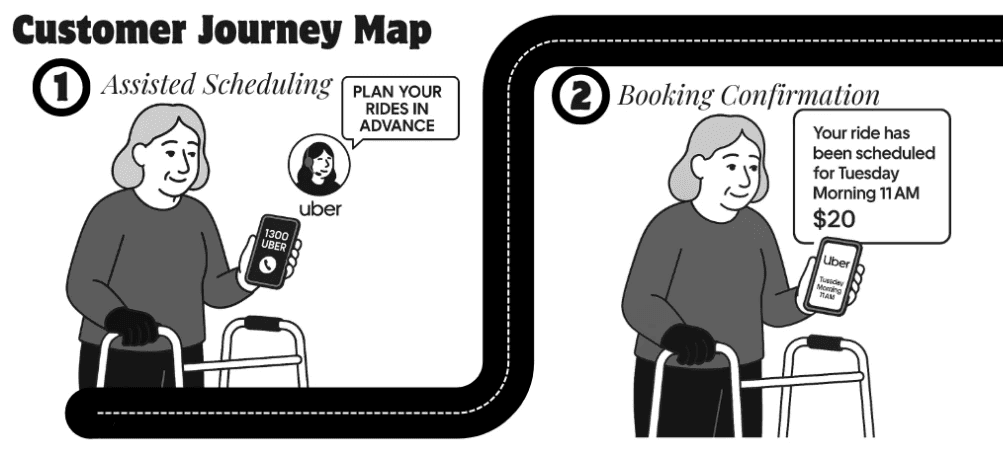
The second: a scheduling service. Pre-book up to 30 days out, fixed price, no surge. Built for the trips that matter most to this group: medical appointments, family visits, weekly commitments. For an older rider a confirmed booking isn't a request that might get cancelled. It's something that's been agreed. Real-time booking can't offer that. Scheduling can.
Both prototyped and tested with real users across two rounds of iteration.
Challenge :
Getting older Australians into structured research took more groundwork than the research did. Ethnographic observation, watching real people in real environments, surfaced things no survey would have found.
The instinct was to fix the app. Larger text, simpler flows, better navigation. All reasonable, none of it right. The barrier wasn't what the app looked like, it was what booking felt like. Once that was clear the solutions followed directly.
Summary :
"Delivered as a group presentation to the RMIT Customer Experience Design cohort. Full Double Diamond process across one semester: discovery, definition, prototyping, testing.
CX vision: Arrive Safely. Book Easily. Pay Clearly.
More Projects


Academic Work
Uber - CX Design
Older Australians were opting out of Uber, and no app update was going to fix it. I ran primary research across interviews, ethnography and eight Reddit communities. Two solutions designed from scratch, prototyped and tested with real users.
Year :
2025
Industry :
Ride-sharing / Tech
Brand :
Uber (academic engagement)
Project Duration :
24 Weeks
Problem :
Older Australians were opting out of Uber. Not because the product was broken, but because the confidence to use it wasn't there. I ran primary research across three methods: in-depth interviews with Australians over 65, ethnographic observation, and analysis across eight Reddit communities.
What came back was consistent. Cancellations created lasting anxiety that stopped people booking again. The app needed more confidence than most older users had going in. And rideshare wasn't how this group thought about getting around in the first place. The problem wasn't the interface.
Solution :
Two solutions, both designed to sit inside Uber's existing infrastructure.
The first: an Uber Wallet top-up at Woolworths. Cash or card at self-checkout, no card on file required. Older Australians trust Woolworths and already go there. The top-up sits inside a system they know rather than one they have to learn.
The second: a scheduling service. Pre-book up to 30 days out, fixed price, no surge. Built for the trips that matter most to this group: medical appointments, family visits, weekly commitments. For an older rider a confirmed booking isn't a request that might get cancelled. It's something that's been agreed. Real-time booking can't offer that. Scheduling can.
Both prototyped and tested with real users across two rounds of iteration.
Challenge :
Getting older Australians into structured research took more groundwork than the research did. Ethnographic observation, watching real people in real environments, surfaced things no survey would have found.
The instinct was to fix the app. Larger text, simpler flows, better navigation. All reasonable, none of it right. The barrier wasn't what the app looked like, it was what booking felt like. Once that was clear the solutions followed directly.
Summary :
"Delivered as a group presentation to the RMIT Customer Experience Design cohort. Full Double Diamond process across one semester: discovery, definition, prototyping, testing.
CX vision: Arrive Safely. Book Easily. Pay Clearly.
More Projects
Academic Work
Uber - CX Design
Older Australians were opting out of Uber, and no app update was going to fix it. I ran primary research across interviews, ethnography and eight Reddit communities. Two solutions designed from scratch, prototyped and tested with real users.
Year :
2025
Industry :
Ride-sharing / Tech
Brand :
Uber (academic engagement)
Project Duration :
24 Weeks
Problem :
Older Australians were opting out of Uber. Not because the product was broken, but because the confidence to use it wasn't there. I ran primary research across three methods: in-depth interviews with Australians over 65, ethnographic observation, and analysis across eight Reddit communities.
What came back was consistent. Cancellations created lasting anxiety that stopped people booking again. The app needed more confidence than most older users had going in. And rideshare wasn't how this group thought about getting around in the first place. The problem wasn't the interface.
Solution :
Two solutions, both designed to sit inside Uber's existing infrastructure.
The first: an Uber Wallet top-up at Woolworths. Cash or card at self-checkout, no card on file required. Older Australians trust Woolworths and already go there. The top-up sits inside a system they know rather than one they have to learn.
The second: a scheduling service. Pre-book up to 30 days out, fixed price, no surge. Built for the trips that matter most to this group: medical appointments, family visits, weekly commitments. For an older rider a confirmed booking isn't a request that might get cancelled. It's something that's been agreed. Real-time booking can't offer that. Scheduling can.
Both prototyped and tested with real users across two rounds of iteration.
Challenge :
Getting older Australians into structured research took more groundwork than the research did. Ethnographic observation, watching real people in real environments, surfaced things no survey would have found.
The instinct was to fix the app. Larger text, simpler flows, better navigation. All reasonable, none of it right. The barrier wasn't what the app looked like, it was what booking felt like. Once that was clear the solutions followed directly.
Summary :
"Delivered as a group presentation to the RMIT Customer Experience Design cohort. Full Double Diamond process across one semester: discovery, definition, prototyping, testing.
CX vision: Arrive Safely. Book Easily. Pay Clearly.